





Quick answer
Power quality problems in a home show up as flickering or dimming lights, breakers that trip without an obvious overload, buzzing dimmers and electronics that reset. The usual causes are loose connections, overloaded or undersized circuits, voltage drop on long runs, motor inrush from HVAC and pool equipment, and occasionally utility supply issues. An audit measures voltage and current under load to find which one you have.
Power quality problems in a home are rarely one dramatic failure. They are the lamp that dims every time the air conditioner starts, the bedroom AFCI that trips once a week, the LED strip that shimmers, the microwave clock that resets. Each symptom has a short list of physical causes, and most of them live in your own wiring rather than on CenterPoint's side of the meter.
This guide walks through those causes the way we diagnose them on a service call, explains voltage drop with real numbers, settles the question of whether harmonics matter in a house, and describes what a proper audit measures. If you want the equipment side of the story, our overview of electrical panel and breaker services covers the upgrades that usually follow.
Key Takeaways
- Flicker in one room is usually a loose connection or an overloaded circuit; flicker in the whole house points to the service or the utility.
- Lights that brighten and dim at the same time signal an open neutral; shut off the main and call an electrician immediately.
- Voltage drop should stay under about 3 percent on a branch circuit and 5 percent meter-to-outlet; long 14-gauge runs often exceed it.
- Nuisance trips come from overloads, motor inrush, AFCI or GFCI sensitivity, shared neutrals and worn breakers, in roughly that order.
- Harmonics from LED drivers and variable-speed motors rarely cause trouble in a home; they matter in commercial three-phase systems.
- A power quality audit logs voltage and current over time under real load, then checks connections with a torque tool and thermal camera.
What Counts as a Power Quality Problem in a Home?
Power quality describes how closely the electricity at your outlets matches the ideal: a clean 60 Hz sine wave at a steady 120 volts, with enough capacity that loads switching on and off do not disturb it. Deviations fall into a few named categories, and naming yours is half the diagnosis:
- Sag (dip). Voltage falls for a few cycles to a few seconds, usually when a motor starts. Seen as a lamp dimming.
- Swell. Voltage rises briefly when a large load drops off.
- Flicker. Repetitive small sags that the eye perceives as shimmer, often from a load that cycles rapidly or a connection that is intermittently making contact.
- Voltage drop. A steady loss of voltage along a conductor under load; the far end of a long circuit reads lower than the panel.
- Transient. A microsecond spike from lightning or switching, covered in our post on transient overvoltage.
- Harmonic distortion. Extra frequencies riding on the 60 Hz wave, produced by electronic loads.
- Interruption. Power lost outright, for a cycle or for days.
A homeowner can usually tell sag from transient by duration: if you could see it, it was a sag or flicker; if a device simply died, suspect a transient.
What Causes Lights to Flicker in a House?
Flicker is the most common power quality complaint we get, and location tells us where to look.
One fixture or one circuit
- A loose connection at a back-stabbed receptacle, a switch, a wire nut or the breaker terminal. Heat cycling in a hot attic loosens them over years. This is a fire risk, not a nuisance.
- An overloaded circuit: a window unit, space heater or hair dryer sharing a 15-amp circuit with the lights.
- LED and dimmer mismatch: a legacy incandescent dimmer driving LED lamps below their minimum load, which our post on LED dimmer buzzing and flickering addresses.
- A failing bulb or driver, the simplest fix of all.
Several rooms or the whole house
- Motor inrush. An air-conditioner compressor can draw five to eight times its running current for a fraction of a second at start. On a service with marginal connections or long conductors, every house light dips.
- A loose service connection at the meter base lugs, main breaker or neutral bar.
- A utility issue: a transformer serving more homes than it was built for, or a damaged service drop.
The dangerous one
If some lights go bright while others go dim, and the pattern shifts as appliances cycle, you have an open or high-resistance neutral. The 240-volt service is now splitting unevenly between the two 120-volt legs. Turn off the main breaker and call us at 832-271-1167; this is an emergency that burns out appliances within minutes.
What Causes Nuisance Breaker Trips?
A nuisance trip is a breaker opening when nothing is obviously wrong. The breaker is almost never the villain; it is reporting something. In order of how often we find them:
- Simple overload. The sum of what is running exceeds the breaker rating. Kitchens, bathrooms and garages with one circuit serving several high-draw devices lead the list.
- Motor inrush on a marginal circuit. A refrigerator, garage compressor or treadmill starting on a circuit already near capacity.
- AFCI sensitivity. Arc-fault breakers detect the signature of arcing. Some older vacuum motors, treadmills and power tools produce a similar signature; so does a genuinely loose connection, which is what the breaker is for. See AFCI protection explained.
- GFCI leakage. Outdoor and garage circuits with moisture in a box, a long run of damp conduit, or several motors adding small leakage currents together.
- Shared or miswired neutral. Two circuits whose neutrals were tied together will trip an AFCI or GFCI as soon as current returns on the wrong path.
- Harmonic-rich loads. Variable-speed pool pumps and HVAC drives can confuse some electronic breakers; usually solved with a breaker type the drive manufacturer approves.
- A worn breaker. Breakers fatigue after years of heat and many trips. Federal Pacific and Zinsco breakers have the opposite failure: they fail to trip.
Our breaker tripping diagnosis guide gives the step-by-step. The rule: reset once; if it trips again, stop resetting and find the cause.
What Is Voltage Drop and How Do You Calculate It?
Every conductor has resistance, so some voltage is lost along the wire whenever current flows. The longer the run and the smaller the wire, the larger the loss. The NEC recommends keeping drop under about 3 percent on a branch circuit and 5 percent for feeder plus branch combined, which on 120 volts means no more than roughly 3.6 volts lost on a branch circuit.
The single-phase formula electricians use:
Voltage drop = 2 × K × I × L ÷ CM
- K is the conductor constant, about 12.9 for copper and 21.2 for aluminum.
- I is the load current in amps.
- L is the one-way length in feet (the 2 accounts for the return path).
- CM is the conductor's circular-mil area: 4,110 for 14 AWG, 6,530 for 12 AWG, 10,380 for 10 AWG.
Worked example: a 12 AWG copper circuit running 100 feet from the panel to a garage workbench carrying 16 amps gives 2 × 12.9 × 16 × 100 ÷ 6,530, which is about 6.3 volts, or 5.3 percent. That is why a table saw bogs down on a code-legal circuit. The same load on 10 AWG drops about 4 volts.
Voltage drop also rises with temperature, so a cable in a 130°F Houston attic loses noticeably more than the same cable at room temperature. Symptoms are worst on August afternoons for a reason. A load calculation tells you how much current the circuit really carries; the formula tells you what the wire does with it.
Do Harmonics Matter in a Residential Electrical System?
Harmonics are currents at multiples of 60 Hz drawn by non-linear loads: anything with a rectifier at its input, which today means LED drivers, computer and TV power supplies, EV chargers, and the variable-frequency drives inside variable-speed HVAC systems and pool pumps. Instead of drawing a smooth sine wave of current, these loads draw it in pulses, and the pulses distort the voltage waveform for everything else on the circuit.
In commercial buildings with three-phase service, harmonics are a genuine engineering problem: the third harmonic from hundreds of computers adds up on the shared neutral, overheats transformers, and justifies harmonic filters or K-rated transformers. In a single-family house on 120/240-volt service, the honest assessment is that harmonics are a minor contributor to the symptoms people notice:
- A faint hum or buzz from a transformer, dimmer or audio equipment when a variable-speed pump or drive runs.
- Occasional nuisance trips of electronic breakers near a VFD, solved with the breaker type the equipment manufacturer specifies.
- Interference on AM radio or audio gear, properly handled by filtering at the sensitive device.
Whole-house harmonic filters are not something we recommend for homes. Where a drive is the source, the equipment manufacturer's line reactor or filter kit, correct grounding and keeping sensitive loads on a separate circuit resolve it. A power quality analyzer can measure total harmonic distortion if there is a real question, and the reading usually confirms the problem is elsewhere.
What Does a Home Power Quality Audit Involve?
An audit replaces guessing with measurement. When The Local Electrician investigates power quality problems in a home, the visit has four parts:
- Interview and map. Which fixtures, when, and what else was running. We identify the circuit for each symptom and note the panel's labeling, age and brand.
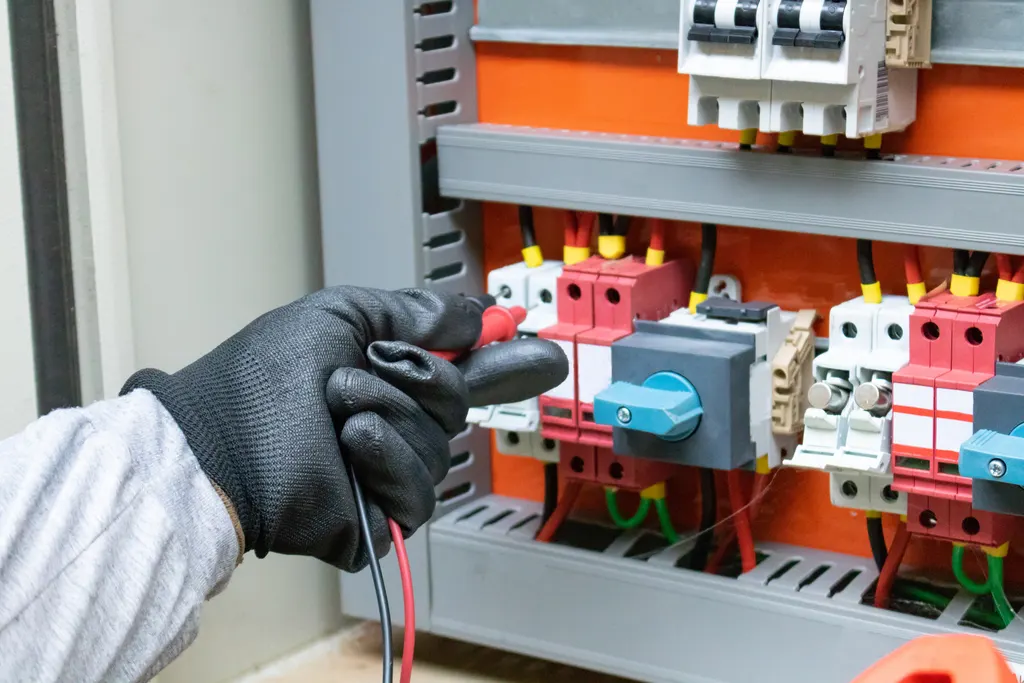
- Static tests. True-RMS voltage at the meter, at the panel and at the far end of the suspect circuits; a clamp meter on each leg to see how the load is balanced; a plug-in tester at receptacles for open grounds and reversed polarity; a torque check of the service lugs and neutral bar; and a thermal camera pass over the panel and any suspect devices under load to catch hot connections.
- Logged tests. For intermittent problems we leave a power quality logger on the service or the suspect circuit for one to three days. It records voltage sags, swells, transients and, where needed, harmonic distortion, with timestamps we can match to the air conditioner cycling or the neighbor's pool pump.
- Findings and fixes. A written explanation of each cause, a corrected panel label, and a prioritized list: safety items first, then the repairs that end the symptom, then optional upgrades.
Readings outside the normal 114 to 126 volt range at the meter go to CenterPoint with our documentation. Utility transformers and service drops are theirs to fix, and they do so at no charge; nothing in a house contains a transformer for us to upgrade other than low-voltage units for doorbells, landscape lighting and HVAC controls.
Power Quality Problems in Katy, Richmond and Friendswood Homes
The west and southwest suburbs give us the same handful of patterns over and over. In Katy and Cinco Ranch, two-story homes built in the late 1990s and 2000s have long branch circuits to upstairs bedrooms, built to code with 14-gauge wire for a world of incandescent lamps and a couple of outlets. Add a gaming computer, a window unit in a converted game room and LED lighting that shows every dip, and the far end of that circuit runs chronically low. In Richmond and Rosenberg, the 1970s and 1980s neighborhoods bring loose connections, panels out of space, and the occasional Federal Pacific or Zinsco panel that we recommend replacing rather than diagnosing.
Closer to the bay, in Friendswood, League City and Pearland, moisture is the recurring factor: GFCI circuits that trip after heavy rain because an outdoor box has filled with water, and corroded meter-base lugs that cause whole-house flicker. Fulshear and the acreage west of the Grand Parkway add long customer-owned service runs where voltage drop happens before the power ever reaches the panel.
Across all of it, the loads have changed faster than the wiring. Variable-speed air conditioners, EV chargers and pool pumps on drives are now routine in homes served by distribution transformers sized decades ago. When a whole street dims at 6 p.m., the report goes to CenterPoint; when one house dims, we can almost always fix it the same day.
How Are Power Quality Problems Fixed, and What Affects the Cost?
Most fixes are mechanical and inexpensive relative to the equipment they protect. From the audit, the typical repair list runs:
- Re-terminating loose connections, replacing back-stabbed receptacles with screw-terminal devices, and torquing the panel.
- Rebalancing loads across the two legs so that neither is carrying most of the house.
- Adding dedicated circuits for the microwave, window unit, treadmill or home office so that they stop sharing with lighting.
- Upsizing conductors on long runs, or adding a subpanel closer to the load.
- Replacing worn or incompatible breakers, including the correct AFCI or GFCI type for the load.
- Installing a surge protective device where transients are part of the picture.
- Replacing the panel or upgrading the service when the panel is undersized, out of space, or a known hazardous brand.
The cost drivers are the number of circuits involved, how far wiring has to be pulled through a finished attic, whether a panel replacement is needed, and permit and inspection requirements, which apply to new circuits, subpanels and service changes throughout Fort Bend and Harris County. The Local Electrician quotes every repair up front, and larger projects such as panel upgrades can use our financing options.
The boundary for homeowners: replacing a bulb, swapping an LED-rated dimmer or moving a load to a different outlet is yours. Anything behind a cover plate or inside the panel is ours.
Frequently Asked Questions
What causes flicker in homes?
Flicker on one circuit is usually a loose connection, an overloaded circuit, or an LED lamp on an incompatible dimmer. Flicker across the whole house points to motor inrush from the air conditioner on a service with loose or undersized connections, or to a utility transformer or service drop problem. Lights that brighten and dim at the same time indicate an open neutral and require shutting off the main breaker immediately.
How does a power quality audit help?
It replaces guesswork with measurements taken under real load: voltage at the meter, panel and far outlets, current on each leg, thermal images of connections, and a logger that records sags, swells and transients over a few days. The result is a specific cause for each symptom and a prioritized repair list, instead of replacing parts until the problem goes away.
What are nuisance trips?
A nuisance trip is a breaker opening when there is no obvious overload or fault. Common causes are motor inrush on a circuit near capacity, AFCI breakers reacting to the arc-like signature of some older motors, GFCI breakers sensing leakage from moisture, neutrals shared between circuits, harmonic-rich loads such as variable-speed drives, and breakers that have simply worn out. The breaker is reporting a condition, not malfunctioning.
Can a power quality audit prevent outages?
It prevents the outages that start inside your house, such as a loose neutral that fails completely, a hot connection that burns open, or a panel that is quietly overheating. It cannot prevent utility outages from storms or grid faults. The audit can also identify supply voltage problems to report to CenterPoint Energy and tell you whether a standby generator or surge protection is a sensible next step.
What tools are used in a power quality audit?
A true-RMS multimeter and clamp meter for voltage and current, a plug-in receptacle tester, a torque screwdriver for terminal checks, a thermal imaging camera for hot connections, and a recording power quality analyzer or logger left on the service for one to three days. For harmonic questions the analyzer reports total harmonic distortion, and for intermittent faults the logger's timestamps are the key evidence.
How much voltage drop is acceptable on a home circuit?
The NEC's recommendation, which The Local Electrician designs to, is no more than about 3 percent on a branch circuit and 5 percent for the feeder and branch circuit combined. On a 120-volt circuit that is roughly 3.6 volts. A 100-foot run of 12 AWG copper at 16 amps already exceeds it, which is why long garage, shop and upstairs circuits often need larger wire or a closer subpanel.
Why do my lights dim when the air conditioner starts?
A compressor draws several times its running current for a fraction of a second at start, and that inrush causes a brief voltage sag. A small dip is normal. A heavy dip, or one that also resets electronics, suggests loose service connections, undersized conductors, a struggling compressor or a utility transformer at capacity. Measuring the sag at the panel and the meter tells us which.