





Quick answer
Transient overvoltage is a voltage spike lasting microseconds, usually caused by lightning, utility switching or motors cycling off, that can reach several thousand volts on a 120-volt circuit. It damages electronics by breaking down semiconductor junctions and insulation. Protection means a bonded grounding system, a surge protective device at the panel, point-of-use protectors at sensitive equipment, and surge protection on coax and data lines.
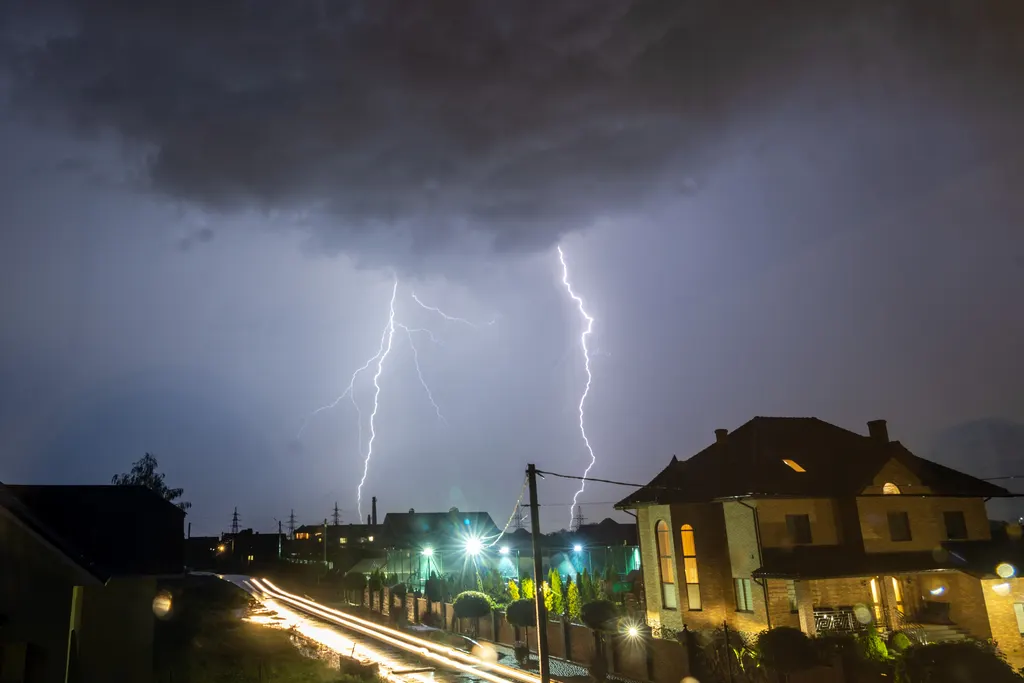
Transient overvoltage is the technical name for what most homeowners call a power surge: a very short, very high spike in voltage that rides into the house on the service conductors, the cable line or even the ground itself. In the Houston area it is a year-round hazard, but the June-to-September lightning season and the grid switching that follows every outage make it the leading cause of dead electronics we see.
This post explains what a transient really is, how lightning gets into a home that was never struck, why smart-home equipment is especially fragile, and the layered protection we install as part of whole house surge protection in Katy, Houston and across Fort Bend County.
Key Takeaways
- Transient overvoltage is a spike measured in microseconds; a swell or sustained overvoltage lasts far longer and is a different problem.
- Most lightning damage comes from strikes on nearby lines or ground, not from a direct hit on the house.
- Surges enter on power conductors, coax, phone and network cables, and through ground potential differences between those systems.
- Semiconductors fail at voltages far below what wiring insulation tolerates, so electronics die first and often fail later rather than instantly.
- Bond every incoming service to one grounding electrode system; unbonded cable and satellite lines are the most common gap.
- A panel SPD, point-of-use protectors and signal-line protectors together stop most transients; a direct strike exceeds any residential device.
What Is Transient Overvoltage?
Electrical engineers sort voltage disturbances by how long they last. A transient is the shortest category: an impulse that rises in about a microsecond and decays within tens of microseconds. Test standards model it with two waveforms, a 1.2/50 microsecond voltage wave and an 8/20 microsecond current wave, which is why you see 8/20 on surge-protector labels.
Three other disturbances get confused with transients and need different fixes:
- Swell. Voltage rises a modest amount for several cycles to a few seconds, typically when a large load drops off the grid. Annoying to electronics, rarely destructive.
- Sustained overvoltage. Voltage stays high for minutes or longer. On a home this is almost always a utility regulation issue or a lost neutral, and it needs a voltage check, not a surge protector.
- Sag or dip. The opposite problem, covered in our guide to power quality problems.
A transient on a 120-volt branch circuit can reach several thousand volts. The energy is small because the time is so short, which is exactly why a device can divert it to ground without harm, and why electronics with no diversion path get destroyed.
How Does Lightning Cause Transient Overvoltage in a Home That Was Never Struck?
A direct strike on a house is rare and no residential protection is rated for it. The common lightning transients arrive four other ways:
- Conducted on utility lines. A strike on a CenterPoint distribution line or pole miles away injects a pulse that travels along the conductors to every service drop on that feeder. The utility's own arresters knock it down but do not eliminate it.
- Induced on long conductors. The magnetic field of a nearby flash induces voltage on any long parallel run of wire: the service drop, the coax from the pedestal, landscape-lighting cable, an invisible-fence loop, or the Ethernet to a detached garage.
- Ground potential rise. When lightning hits the ground, the earth near the strike sits at a much higher voltage than earth farther away for a few microseconds. If your electrical ground rod, your cable-company ground and your well casing are at different potentials, current flows between them through your equipment.
- Through signal lines. Coax, satellite, phone and fiber-to-copper converters bring their own path into the house and bypass the panel entirely.
That fourth path explains the most common surge call we get: a modem, router and the television connected to it are dead, while everything on the power side is fine. The spike came in on the cable line.
How Does Transient Overvoltage Damage Electronics?
House wiring is insulated for 600 volts and tolerates a brief transient well above that. The semiconductors inside modern equipment are not. A diode, MOSFET or microcontroller pin may have a breakdown rating of a few dozen volts; a transient that gets past the device's own small input protection punches through the junction in the time it takes the pulse to peak.
Failure looks different depending on the energy:
- Catastrophic. The device is dead immediately. Scorch marks on the circuit board, a split capacitor or a blown input fuse are typical.
- Latent. The junction is weakened, not destroyed. The appliance keeps working for weeks or months, then fails on an ordinary day. This is why a garage-door opener that quits in October may still be a July lightning casualty.
- Degraded. Repeated small transients from motors inside the house slowly dry out capacitors and erode power-supply components. The device never fails spectacularly; it just gets flaky, resets, or runs hot.
The equipment at highest risk is anything with a switching power supply and a connection to two systems at once: a smart TV on power and coax, a security camera on PoE and the network, an HVAC communicating thermostat on 24 volts and Wi-Fi. Two paths in means a voltage difference can develop across the device.
Which Smart-Home Devices Are Most Vulnerable, and How Do You Protect Them?
The shift to connected homes has multiplied the number of low-voltage electronics tied to the house wiring. In a typical Katy home we now find a mesh router, a video doorbell, several cameras, a smart thermostat, Wi-Fi switches and dimmers, a garage controller, an irrigation controller and a pool automation panel. Each contains a radio and a microcontroller, and most sit on the end of a long cable run.
Protection by device type:
- Network and cameras. Use an inline Ethernet or PoE surge protector where any outdoor cable enters the house, bonded to the electrical ground. Mount the switch and NVR on a surge receptacle or a small UPS.
- Smart switches and dimmers. These sit directly on the branch circuit and rely on the panel SPD; there is nowhere to plug in a strip. This is the strongest argument for whole-home protection.
- Thermostats and HVAC boards. Protected by the panel SPD on the 240-volt side; ask your HVAC contractor about a low-voltage surge module for the 24-volt control circuit.
- Irrigation and pool controllers. Long outdoor wire runs make them induced-surge magnets. A Type 2 SPD at the pool subpanel and proper pool equipment bonding are the fixes.
Our post on reducing electrical interference in smart home systems covers the noise side of the same problem.
Why Grounding and Bonding Come Before Any Surge Device
Every surge protector, from the panel unit to the strip under the desk, works by giving the transient a shorter path to earth than the one through your equipment. If that path is broken, the device is decoration. Before installing anything, we check four things:
- Grounding electrode. Slab homes in Fort Bend County depend on driven rods; we confirm the rod, the clamp and the conductor are intact and not corroded through by humidity and irrigation.
- Main bonding jumper. Neutral and ground must be bonded at the service disconnect and nowhere downstream.
- Intersystem bonding. The cable, satellite and phone grounds must land on the same electrode system as the electrical service, through the intersystem bonding termination the NEC requires at the service. The cable installer's lone clamp on a hose bib does not count.
- Metal piping and the pool. Gas piping, metal water piping and pool steel must be bonded so they cannot sit at a different potential from the electrical system.
Our electrical grounding and bonding guide goes deeper. The short version: unbonded coax is the single most common gap we find in otherwise well-protected homes, and it is also the least expensive to fix.
Transient Overvoltage Risk in Houston and Katy Homes
Houston sits on one of the most lightning-active stretches of coastline in the United States, with sea-breeze thunderstorms firing most summer afternoons. The west-side suburbs along I-10 and the Grand Parkway, from the Energy Corridor out through Katy and Fulshear, are flat, open and served by long overhead feeders, which is ideal geometry for induced transients. In 1990s neighborhoods like Kelliwood and Nottingham Country we also see original cable and phone drops that were never bonded to the electrical ground.
Grid switching is the other half of the local picture. After Hurricane Beryl in July 2024 and the May 2024 derecho, CenterPoint Energy restored power in stages across Houston. Each re-energization produced switching transients, and the week after each event The Local Electrician replaced more HVAC control boards, garage-door logic boards and well-pump controllers than in a typical quarter.
Our advice to homeowners here is specific. If a storm is overhead, unplug what you can and do not rely on a strip to protect a computer that is also on Ethernet. If power goes out, switch off the breakers for the air conditioner and any sensitive equipment, and turn them back on a few minutes after service returns, once the restoration transients have settled. And treat a whole-home SPD as basic equipment, the same as smoke detectors.
What Can You Do Yourself, and When Do You Need a Licensed Electrician?
Homeowner-safe steps that cut transient exposure right away:
- Install UL-listed Type 3 surge strips or surge receptacle adapters at the television, home office and network gear, and replace any strip whose protection indicator is dark.
- Add inline coax and Ethernet surge protectors at the modem and at any cable that runs outdoors.
- Put network equipment and a desktop computer on a small UPS, which adds filtering as well as ride-through.
- Unplug portable equipment during a direct thunderstorm, and remember that an outlet switch does not disconnect the neutral.
Work that should go to a licensed electrician, and in most of our area is permitted and inspected:
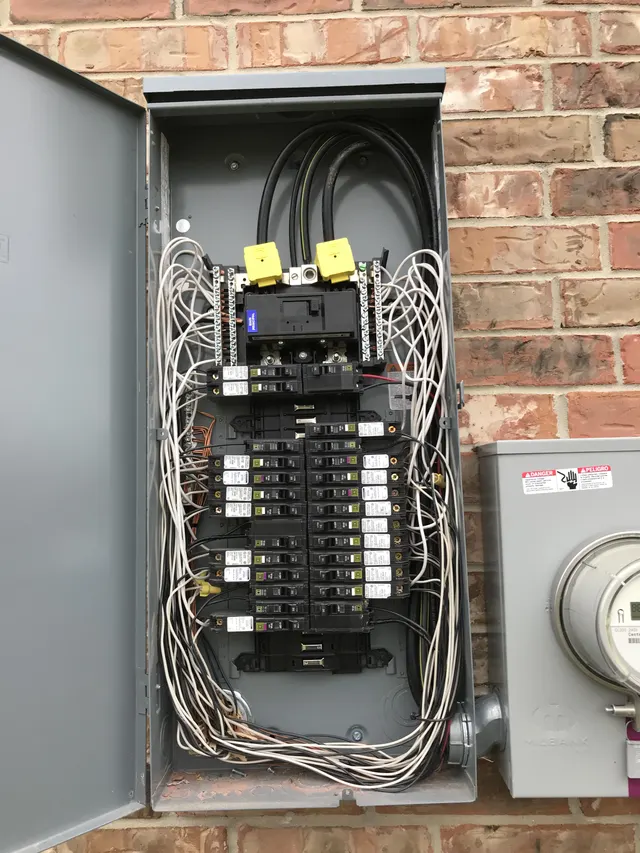
- Installing or replacing a panel-mounted Type 1 or Type 2 SPD, which means working on live bus bars.
- Correcting grounding electrode or intersystem bonding deficiencies.
- Adding a Type 2 device at a pool subpanel, detached garage or generator transfer switch.
- Diagnosing a sustained overvoltage, which can indicate an open neutral and is an emergency.
If lights in the house suddenly get very bright or very dim at the same time, shut off the main breaker and call us at 832-271-1167; that symptom is not a transient, and it can destroy everything in the house within minutes. The Local Electrician answers 24/7 for emergency electrical repairs.
Frequently Asked Questions
What causes transient overvoltage?
Lightning is the largest source, through strikes on utility lines, induction on long cables and ground potential rise near the strike point. Utility switching, including reclosers and capacitor banks operating and power restoration after outages, is the second. Inside the house, every motor that cycles off, from the air-conditioner compressor to a vacuum cleaner, produces a small transient as its magnetic field collapses.
What is transient overvoltage?
It is a voltage spike that lasts microseconds, rising far above the normal 120 or 240 volts and then disappearing. Engineers distinguish it from a swell, which lasts cycles to seconds, and from sustained overvoltage, which lasts minutes or longer. Transients carry little total energy but enough peak voltage to break down the semiconductors inside modern electronics.
Can lightning damage all home devices?
Anything connected to the electrical system or to a signal line can be affected, but the risk is uneven. Simple resistive loads such as an electric water heater element or an incandescent bulb shrug off transients. Devices with electronic power supplies, radios and microcontrollers fail first, and devices connected to two systems at once, such as a smart TV on power and coax, are the most exposed.
How can smart homes be protected from transient overvoltage?
Start with a verified grounding electrode system and intersystem bonding of cable, satellite and phone lines. Add a Type 2 surge protective device at the main panel and at any remote subpanel, point-of-use surge protection at the router, television and office, inline protectors on Ethernet and coax, and a small UPS for network gear. Smart switches and dimmers depend entirely on the panel device.
How can I detect surge damage early?
Watch for devices that reset, lose Wi-Fi, run hot or behave erratically after a storm or outage, since latent surge damage often shows up weeks later. A dark indicator on a surge strip, a tripped SPD status light, a dead garage-door opener or a thermostat that reboots are classic signs. The Local Electrician can check SPD status, grounding and bonding during a home electrical inspection.
Should I unplug electronics during a thunderstorm in Houston?
For portable equipment, yes, when a storm is directly overhead; unplugging the power cord and the coax or Ethernet removes every path. It is not practical for hard-wired equipment such as the air conditioner, oven or smart switches, which is why a panel-mounted surge protective device matters. Do not touch cords or outlets while lightning is active nearby.