





Quick answer
An AFCI outlet or arc fault circuit interrupter breaker detects the electrical signature of arcing, the sparking at a loose connection, a damaged cable or a frayed cord, and opens the circuit before the arc can ignite insulation or wood. The NEC requires AFCI protection on nearly every 120-volt circuit serving bedrooms, living areas, kitchens, hallways and laundry rooms, and when those circuits are extended.
A standard breaker protects wire from carrying too much current. A GFCI protects people from current leaking to ground. Neither does anything about a loose screw terminal in a bedroom outlet that has been arcing quietly for months, heating the box a little more each night. That gap is what an AFCI outlet or arc fault breaker closes, and it is why arc fault protection became a code requirement for the rooms where people sleep.
This guide explains how AFCIs work, where the 2023 NEC as adopted in Texas requires them, how to choose between an AFCI breaker and an AFCI receptacle, what causes arc faults in Katy, TX and Richmond homes, and how to deal with an AFCI that keeps tripping. For a retrofit, start with our outlet and device installation service.
Key Takeaways
- An AFCI detects the current waveform of arcing and trips before the arc can start a fire; a standard breaker cannot see an arc.
- The NEC requires AFCI protection on 15-amp and 20-amp circuits serving bedrooms, living areas, kitchens, hallways, closets and laundry areas.
- Extending a circuit or replacing a receptacle in an AFCI-required area triggers the requirement in an existing home.
- AFCI breakers protect the whole circuit; an AFCI receptacle at the first outlet is allowed only when the home-run wiring meets specific conditions.
- An AFCI that trips with everything unplugged is reporting a wiring fault, not a nuisance, and needs a licensed electrician.
What is an AFCI outlet, and how does it differ from a breaker or GFCI?
An arc fault is current jumping across a gap it should not: between a loose wire and its terminal, through a cable crushed by a staple, inside a cord bent too many times behind a sofa. Arcs run at thousands of degrees, but they draw too little current to trip a breaker and leak nothing to ground, so a GFCI ignores them. An AFCI watches the shape of the current waveform instead. Arcing produces a chaotic, high-frequency pattern; when the device sees it for more than a few cycles, it opens the circuit.
AFCIs come in two packages:
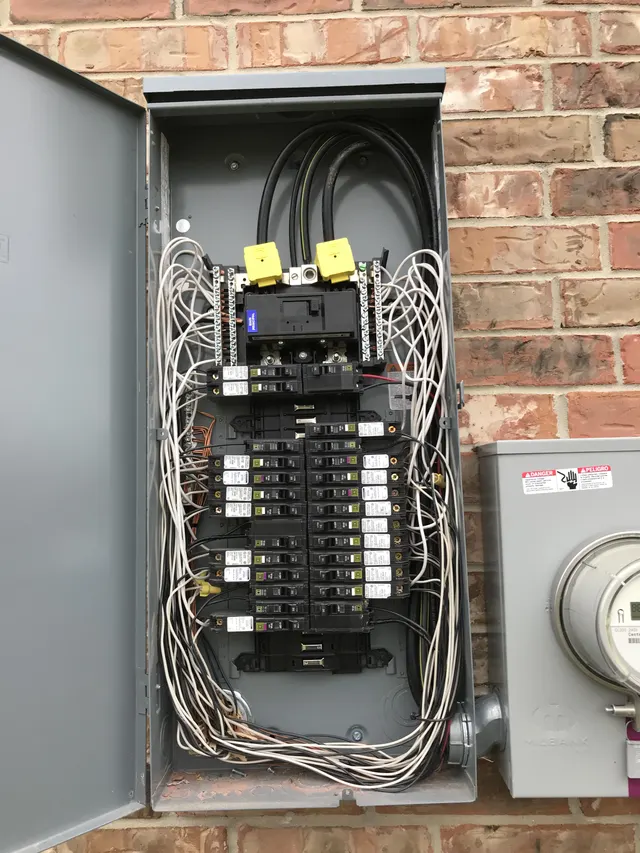
- Combination AFCI breaker. Installed in the panel in place of a standard breaker, protecting every foot of the circuit, including the cable inside the walls.
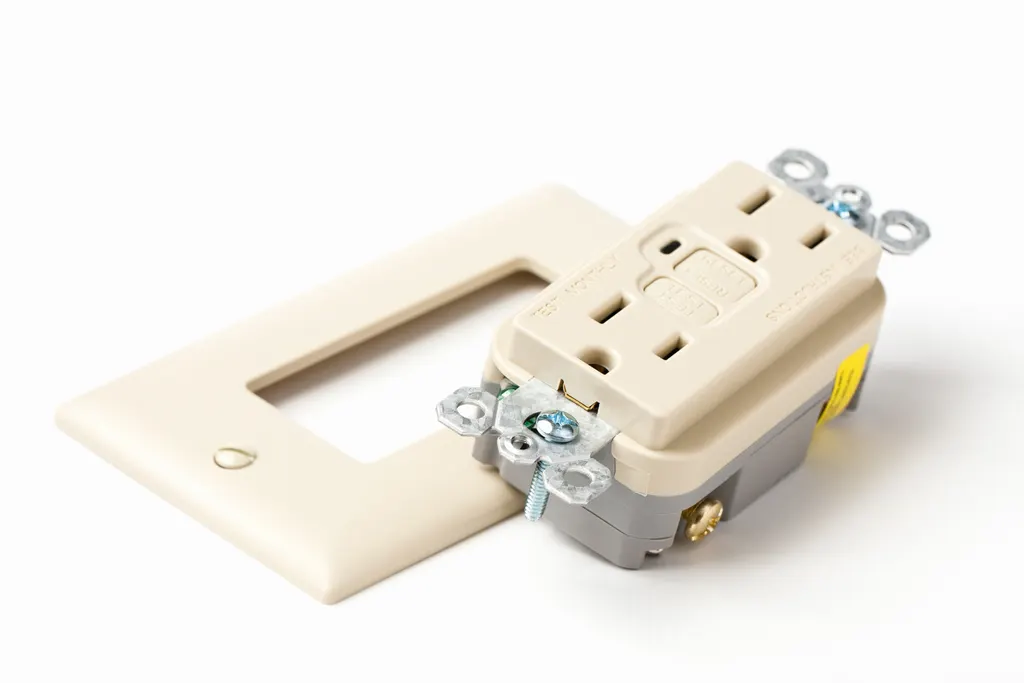
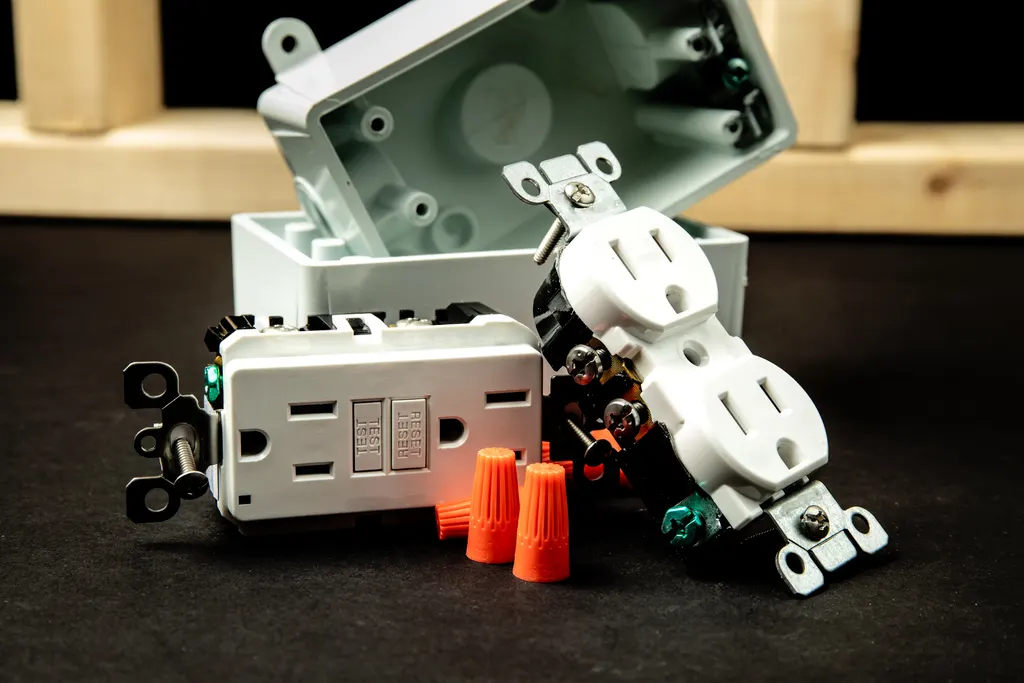
- Outlet branch-circuit (OBC) AFCI receptacle. A device that looks like a GFCI, installed at the first outlet of a circuit. It protects itself, its downstream outlets and the cords plugged into them, but not the home-run cable between it and the panel unless that cable meets conditions explained below.
A series arc occurs in one conductor, at a loose terminal or broken strand. A parallel arc jumps between hot and neutral or hot and ground through damaged insulation and releases far more energy. Combination-type AFCIs, the only kind sold today, detect both. Dual-function devices add GFCI protection, so one breaker can satisfy both rules in a kitchen; our GFCI guide covers the shock side.
Where does the NEC require AFCI protection?
NEC 210.12(A) requires arc fault protection for all 120-volt, 15-amp and 20-amp branch circuits supplying outlets and devices in dwelling unit kitchens, family rooms, dining rooms, living rooms, libraries, dens, bedrooms, sunrooms, recreation rooms, closets, hallways, laundry areas and similar rooms. In a typical house that leaves out only bathrooms, garages, unfinished attics, outdoor circuits and dedicated appliance circuits such as the range or dryer. It applies to lighting and smoke-detector circuits in those rooms, not just receptacles.
Two retrofit rules bring existing homes into scope:
- Extending or modifying a circuit. Under 210.12(D), when a branch circuit in an AFCI-required area is extended or modified, it must be AFCI protected, with a breaker or with an OBC AFCI receptacle at the first outlet of the extension. Adding a receptacle to a bedroom wall in a 1985 Katy home therefore brings an AFCI with it.
- Replacing a receptacle. Under 406.4(D)(4), a receptacle replaced in an AFCI-required location must be AFCI protected, by an AFCI breaker, an OBC AFCI receptacle, or a receptacle fed from one.
Untouched circuits in older homes remain grandfathered. There is no requirement to add AFCI breakers to a 1990s panel for its own sake, though we recommend it for bedrooms when a panel is replaced anyway. Our Texas residential code guide covers local adoption.
AFCI outlet or AFCI breaker: which is better?
For new circuits and panel replacements, the breaker wins. It protects the entire circuit, home run included, and the diagnostic indicator on modern AFCI breakers reports whether the last trip was an arc, a ground fault or an overload. The receptacle form exists mainly for retrofits: the code allows an OBC AFCI at the first outlet as the sole protection only when the home run is in metal conduit or metal-clad cable, or is a short run of a listed combination with a matching breaker. In a slab-on-grade Houston house with NM cable through the attic, that is rarely the case.
Where an AFCI receptacle is still the right call:
- The panel has no AFCI breaker available for it. Many older panels, and every Federal Pacific and Zinsco panel, have no listed AFCI. Replacing the panel is the real fix, covered in our guide to signs you need a panel upgrade; an OBC AFCI at the first outlet is the interim option.
- A circuit extension in one room needs protection for the new section only.
- A multiwire branch circuit shares a neutral between two breakers. Standard AFCI breakers cannot be used there without a two-pole AFCI; receptacles sidestep the problem.
Either way the device needs a deep box, a correctly identified line cable, and a breaker listed for that panel. Mixing breaker brands voids the listing and fails inspection.
What causes arc faults in Houston-area homes?
Arcs start at connections and at damaged insulation, and the housing stock and climate here produce both. The causes we trace most often:
- Back-stabbed receptacles and switches. The spring clips behind 1980s and 1990s devices loosen with decades of heat cycling. A loose clip is a series arc waiting for a space heater.
- Attic heat. Cable run through an attic that reaches 130°F or more every summer ages faster. Older NM cable with 60°C insulation becomes brittle and cracks where it bends at a box.
- Aluminum branch wiring. Late-1960s and 1970s homes with aluminum conductors on standard devices develop high-resistance terminations that arc. See our guide on whether aluminum wiring is safe.
- Nails and screws. A picture hanger, a towel bar or a cabinet screw driven into a cable creates a parallel fault that may not show up for years.
- Rodents. Rats and squirrels in the attic chew insulation down to bare copper.
- Cords and plugs. Lamp cords pinched under furniture, extension cords under rugs, and frayed appliance plugs are the arc sources an AFCI receptacle protects against most directly.
- Storm and flood damage. Boxes that took on water during Hurricane Beryl or the May 2024 derecho corrode and arc months later.
Any of these shows up first as a tripped AFCI, which is the point of the device.
Why does my AFCI keep tripping?
An AFCI that trips is either reporting an arc or being fooled by something that looks like one. Homeowners can narrow it down safely:
- Unplug every cord on the circuit and switch off every light. Reset the breaker or receptacle.
- If it trips with nothing connected, the fault is in the wiring, the devices or the breaker itself. Stop and call a licensed electrician.
- If it holds, plug loads back one at a time, running each for a few minutes. The load that trips it is the suspect: a frayed vacuum cord, a treadmill, an old window unit, a lamp with a cracked socket.
True nuisance trips, where nothing is arcing, have a short list of causes:
- Shared neutrals. A neutral tied to another circuit, or touching ground in a box, trips an AFCI immediately and is a wiring fault to correct.
- Older brushed motors. Early AFCIs mistook the sparking of some vacuum and power-tool motors for faults. Current devices filter this well; a trip from a modern appliance usually means the appliance is worn.
- Surges. Lightning and grid switching can trip AFCIs across the house at once. Repeated surge trips are a reason to look at whole-home surge protection.
- A failing AFCI. Like any electronic device, they wear out, especially after surge events.
Never replace a tripping AFCI with a standard breaker to make the problem go away. That removes the warning while leaving the arc.
How do electricians diagnose arc faults?
When an AFCI trips with nothing plugged in, the fault is somewhere in the fixed wiring, and finding it is systematic work rather than guesswork. The sequence we use:
- Read the breaker. Newer AFCI breakers store the cause of the last trip and display it with an LED code when a button is pressed: arc, ground fault, overload or short. This alone eliminates half the possibilities.
- Inspect every box on the circuit. With the circuit dead and verified, we open each receptacle, switch and junction box looking for back-stabbed conductors, loose terminals, scorched insulation, nicked conductors, aluminum on copper-only devices, and neutrals touching ground. Most arc faults are found here.
- Isolate by sections. Disconnecting the circuit at a midpoint box and testing each half narrows the search to one run of cable.
- Insulation resistance testing. A megohmmeter applies a test voltage between conductors to reveal damaged insulation inside a wall that visual inspection cannot reach, such as a cable nicked by a screw.
- Thermal imaging. With the circuit loaded, an infrared camera shows a warm connection behind a cover plate before it fails.
- Verify the repair. Reconnect, load the circuit, and confirm the AFCI holds.
This is also where we find problems unrelated to the AFCI: a junction box buried behind drywall, or cable rated for 60°C running through a 140°F attic. Those get written up as part of an electrical inspection.
Arc flash versus arc fault: what homeowners should know
The two terms get confused, and they describe different hazards. An arc fault is the small, sustained arc inside wiring or a device that AFCIs are built to catch; its danger is fire. An arc flash is the explosive release of energy when a large fault occurs across live parts that can supply high current, most often at the service entrance or inside a panel; its danger is burn injury to whoever is standing in front of it.
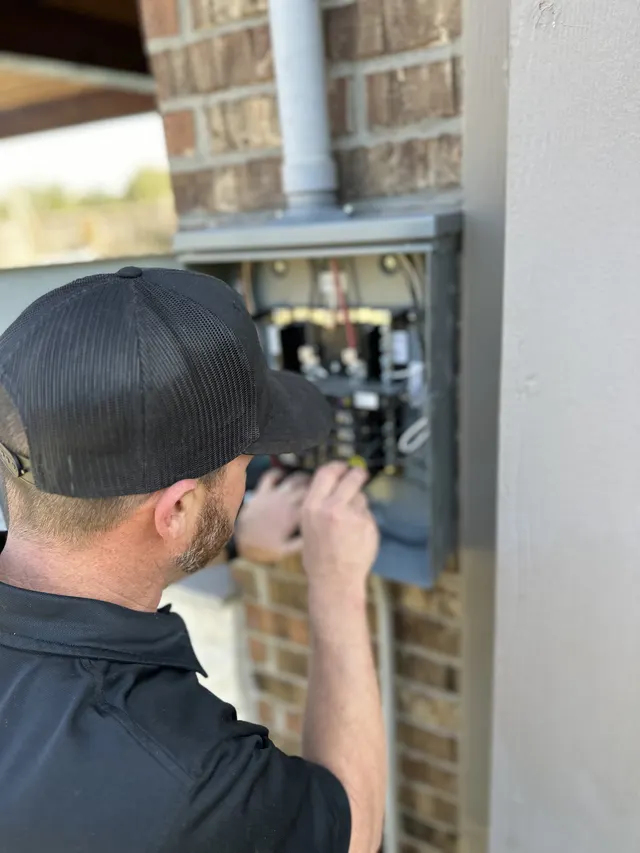
In a house, arc flash risk concentrates at the panel and the meter base, where conductors are fed directly from CenterPoint's transformer with nothing upstream to limit a fault. That is why panel work is done in rated gloves and face protection. For homeowners, the practical rules are short:
- Do not remove a panel cover or meter cover yourself. Turning off the main breaker does not de-energize the service conductors feeding it.
- Do not reset a breaker that trips immediately and hard, with a bang or a flash. That is a short circuit, and repeated resets feed the fault.
- Treat a buzzing, warm or discolored panel as an emergency. Federal Pacific Stab-Lok and Zinsco panels are known for breakers that fail to trip, which is how a short becomes an arc flash.
- Keep the area in front of the panel clear.
AFCIs reduce fires; they do not prevent arc flash. A sound panel with breakers that trip when they should is what does that.
AFCI upgrades in Katy, Pearland and Richmond homes
Houses built in Fort Bend and Harris County since the 2008 code cycle usually arrived with AFCI breakers on the bedroom circuits, and homes built since the mid-2010s have them on most of the panel. The master-planned communities around Richmond and Katy, including Aliana, Harvest Green and the newer sections of Cinco Ranch, are in that group. Service calls there are mostly a tripping AFCI on a circuit that picked up a new treadmill or a failing window unit, or dual-function breakers for a kitchen remodel.
The retrofit work is in the 1970s through 1990s subdivisions of older Katy, Pearland, Quail Valley and Pecan Grove. Those homes have no arc fault protection, and many have the panels that make adding it difficult: Federal Pacific, Zinsco and early Challenger equipment with no listed AFCI breakers, or panels too full for a wider AFCI. When one of those panels is replaced, we install AFCI breakers on every circuit the code would require in new construction, which turns a panel job into a whole-home fire-protection upgrade.
A breaker swap on an existing circuit needs no permit; a panel replacement, circuit extension or new circuit is permitted and inspected by the city inside Katy, Pearland or Richmond limits and by the county outside them. Attic heat, rodents in older attics and the storm damage left by Beryl and the derecho are the local reasons AFCIs trip here more than the textbook predicts. The Local Electrician diagnoses those trips rather than defeating them.
Should you install AFCI outlets yourself, and what affects the cost?
Installing an AFCI breaker means working inside a panel with the service conductors live, which is not homeowner work. Installing an AFCI receptacle is closer to a GFCI swap, but it only protects what is downstream, so putting it anywhere other than the first outlet on the circuit accomplishes much less than it appears to. Identifying that first outlet, confirming the home run qualifies, and sorting out a shared neutral are the parts that take an electrician. Call The Local Electrician for any AFCI work beyond a one-for-one receptacle replacement, and for any AFCI that trips with nothing plugged in.
What drives the cost of AFCI protection:
- Breaker or receptacle. AFCI and dual-function breakers cost more than standard breakers and are priced per circuit.
- Panel compatibility. A panel with no listed AFCI breakers needs replacing before the breakers can go in, which is the largest variable.
- Number of circuits. Protecting bedrooms only is a smaller job than protecting every circuit the current code names.
- Wiring faults found. Shared neutrals, back-stabbed devices and damaged cable have to be corrected before an AFCI will hold.
- Diagnostic time. Tracing an intermittent arc fault is billed on the time it takes.
We provide upfront pricing after seeing the panel, free estimates on installations, and financing for panel replacements. If an AFCI is tripping and you smell burning or see scorching anywhere, leave the breaker off and call 832-271-1167.
Frequently Asked Questions
Why should I consider AFCI outlet upgrades, and what are their benefits?
AFCI protection catches the arcing at loose connections, damaged cables and frayed cords that standard breakers and GFCIs cannot detect, and it opens the circuit before the arc ignites wood or insulation. The benefit is fire prevention in bedrooms and living areas. It is also required by code whenever a circuit in those rooms is extended or a receptacle replaced.
How do AFCI outlets make older homes in Katy, TX safer?
Older Katy homes have the conditions that produce arcs: back-stabbed 1980s devices, cable aged by attic heat, aluminum wiring in the oldest subdivisions, and rodent damage. An AFCI breaker or receptacle on those circuits detects the arc signature and trips before a fire starts, and the trip itself points the electrician to the failing connection so it can be repaired.
Are AFCI and GFCI outlets the same?
No. A GFCI compares current on the hot and neutral and trips when about 5 milliamps leaks to ground, protecting people from shock in wet areas. An AFCI analyzes the current waveform for the pattern of arcing and trips to prevent fire in living areas. Dual-function breakers and receptacles combine both, which is how kitchens and laundry rooms now meet both requirements.
Can I install AFCI outlets myself?
An AFCI receptacle wires like a GFCI, but it only protects outlets downstream of it, so it must go at the first outlet on the circuit, which takes a meter and some tracing to identify. AFCI breakers involve working in a live panel and are not a homeowner job. The Local Electrician handles both and corrects the shared neutrals and loose connections that cause nuisance trips.
Do I need to consider AFCI outlet upgrades for all outlets in my home?
Not all. The NEC requires arc fault protection on 120-volt circuits serving bedrooms, living areas, kitchens, dining rooms, hallways, closets and laundry areas. Bathrooms, garages, outdoor circuits and dedicated 240-volt appliance circuits are not included. In an existing home the requirement applies when those circuits are extended or their receptacles replaced, or when the panel is replaced.
Why does my AFCI breaker trip when nothing is plugged in?
A trip with every cord unplugged and every light off means the breaker is detecting a fault in the fixed wiring or devices: a loose terminal, a nicked cable, a neutral touching ground, a shared neutral, or a failing breaker. That is a real problem rather than a nuisance. Leave the breaker off and have a licensed electrician trace the circuit.
What is the difference between an arc fault and an arc flash?
An arc fault is a small sustained arc inside wiring or a device, dangerous because it ignites fires; AFCIs are designed to catch it. An arc flash is an explosive release of energy from a high-current fault, usually at a panel or meter, dangerous because of burns. AFCIs reduce fires; a sound panel with breakers that trip reliably reduces arc flash risk.