




Quick answer
LED recessed lighting sits inside the ceiling and gives even, low-profile general light, which suits kitchens, living rooms, hallways and low ceilings. Track lighting mounts on the ceiling surface with adjustable heads and suits accent lighting for art, shelves and kitchens where you cannot cut into the ceiling. Choose recessed for ambient light and clean lines; choose track for aimable light and easy changes.
Homeowners usually ask this question while planning a kitchen remodel or trying to fix a dim living room, and the answer depends on three things: what the light needs to do, what the ceiling allows, and what sits above it. LED recessed lighting and LED track lighting both run cool and efficient, so the decision is about geometry, access and look rather than energy.
We install both across Katy, Richmond, Sugar Land and west Houston, and this guide explains how we decide. It also covers the recessed choice that matters most in a Texas attic: IC-rated airtight cans versus canless wafer lights. For the full range of ceiling fixtures we install, see our indoor lighting installation page.
Key Takeaways
- Recessed lighting is for even ambient light; track lighting is for adjustable accent light you can re-aim.
- Recessed cans in an insulated attic must be IC-rated and airtight; canless LED wafers meet both requirements by design.
- Space recessed lights at roughly half the ceiling height apart and keep them 2 to 3 feet off the walls.
- Track lighting installs on one existing ceiling box, which makes it the practical choice where the ceiling cannot be opened.
- Both types dim well only with LED-rated dimmers matched to the fixture driver.
- Adding either on a new circuit is permitted and inspected work in Fort Bend and Harris County.
What Is the Difference Between LED Recessed Lighting and Track Lighting?
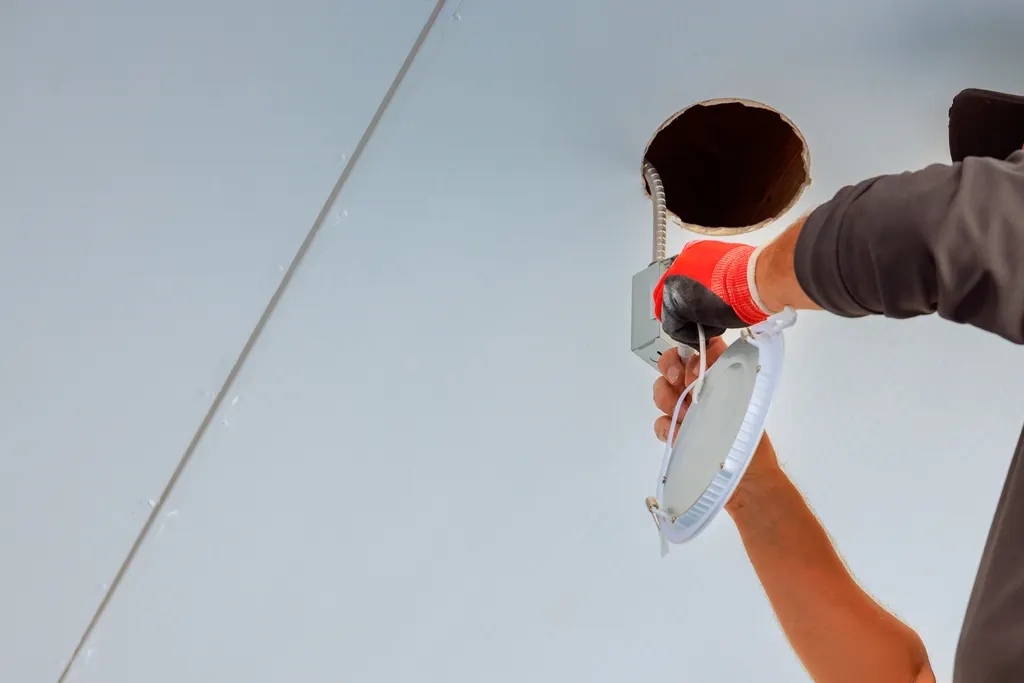
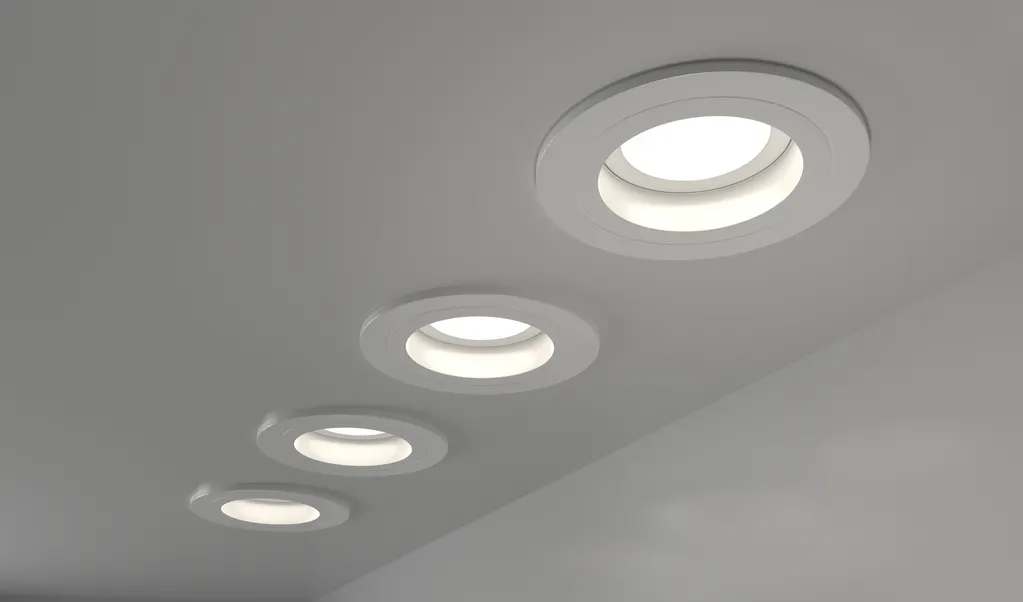
LED recessed lighting is any fixture whose body sits above the ceiling plane. It comes in two forms. A can (housing) is a metal cylinder mounted between joists with a trim and lamp or LED module at the opening. A canless wafer is a thin, sealed LED panel with a remote junction box that clips into a hole in the drywall and needs only about an inch of depth. From the room, both read as a flat disc of light.
Track lighting is a surface-mounted rail that carries power along its length, with individual heads that clip on anywhere and aim in any direction. Modern LED heads use integrated modules or replaceable GU10 and MR16 lamps. Monorail and cable systems are low-voltage variants of the same idea, with a transformer in the canopy.
The practical differences:
- Light direction. Recessed throws light down in a fixed cone. Track heads aim where you point them and can be moved later.
- Ceiling impact. Recessed needs a hole per fixture and access above or a remodel housing. Track needs one existing box.
- Look. Recessed disappears. Track is visible hardware, which reads as intentional in a kitchen or gallery wall and as clutter in a bedroom.
- Count. A room usually needs several recessed lights but a single track with three to six heads.
Which Rooms Suit Recessed Lighting and Which Suit Track?
Choose LED recessed lighting for
- Kitchens. Evenly spaced 4-inch or 6-inch lights over the work triangle, with a row positioned so you do not stand in your own shadow at the counter.
- Living and family rooms. General fill on a dimmer, often paired with lamps.
- Hallways, closets and bathrooms. Low ceilings where any surface fixture would be in the way.
- Covered patios and soffits. Wet-rated recessed fixtures in an eave light the entry and driveway without visible hardware.
Choose track lighting for
- Art walls, bookcases and fireplaces. Aimable heads with narrow beam angles make accent lighting work.
- Kitchens in condos or slab-ceiling rooms where there is no attic and the ceiling cannot be opened cleanly.
- Home offices and craft rooms where the task area moves.
- Sloped and vaulted ceilings where recessed trims would need special sloped-ceiling housings and still point at the wrong wall.
Many of the best rooms use both: recessed for the base layer and a short track or a pair of adjustable recessed gimbals on a separate dimmer for the focal point. If you are still weighing fixture styles generally, our lighting installation guide covers ambient, task and accent layering.
IC-Rated Airtight Cans or Canless Wafer Lights: Which Should You Choose?
This is the question that decides whether LED recessed lighting lasts in a Houston attic. Attic insulation sits directly on top of ceiling fixtures, and attic air in July runs well above 130°F.
IC-rated means the housing is listed for direct contact with insulation. A non-IC can must be kept clear of insulation by at least 3 inches, which leaves a gap that leaks conditioned air and is almost never maintained after the insulation contractor leaves. Airtight (AT) means the housing is sealed against air movement between the room and the attic, which the energy codes adopted locally require for new recessed fixtures in the building envelope.
A traditional IC-AT can with an LED retrofit trim is a good product when there is attic access and the look of a deeper trim is wanted. Its weakness is heat: the LED driver sits up inside the housing, in the hottest air in the house.
Canless wafers solve that. The fixture is a sealed LED disc, inherently IC-rated and airtight, with a small driver box that lies beside it on the drywall. They fit in a 2x4 ceiling, under ductwork and in rooms with no attic access, and are installed from below. The trade-offs: the whole unit is replaced when it fails, the beam is wider and flatter, and very cheap wafers flicker on dimmers.
Our general rule in new installs: wafers for most rooms, IC-AT cans with quality trims where the client wants a deeper, more directional look, and a remodel-style housing only where neither works.
How Do You Plan a Recessed Lighting Layout?
Good layouts come from four numbers.
- Spacing. Divide the ceiling height by two for the distance between fixtures. In an 8-foot room that is about 4 feet apart; in a 10-foot room, 5 feet. Keep the outer row 2 to 3 feet off the wall so the light washes the wall instead of scalloping it.
- Lumens. Kitchens and work areas want more light per square foot than bedrooms. A typical 6-inch LED fixture delivers 700 to 1,100 lumens; 4-inch units run lower. Count fixtures from the lumens you need, then adjust spacing to fit.
- Beam angle. Wide (90 degrees or more) for general fill; 40 degrees or narrower for accent. Adjustable gimbal trims let one layout do both.
- Color temperature. 2700K to 3000K for living spaces, 3000K to 4000K for kitchens and baths, and one value per room. Choose 90 CRI or better anywhere color matters.
Lay the grid out on paper, then check it against the joist layout, HVAC ducts and plumbing in the attic. Fixtures that land on a joist get shifted an inch or two; fixtures that land under a duct become wafers. Put kitchen and living room on separate dimmers, and add a switch leg for any accent fixtures so they can be controlled independently.
Dimmers deserve a sentence of their own: an incandescent dimmer will make LED fixtures flicker and hum. Use an LED-rated dimmer matched to the fixture's driver, which we explain in LED dimmer buzzing and flickering fixes.
What Should You Know About Track Lighting Heads, Dimming and Installation?
Track systems are not all interchangeable. Line-voltage track comes in three common connector standards (often called H, J and L types), and heads only fit the track they were made for. Buy the track and heads as a matched set, and note the standard for future additions.
The heads decide the light quality:
- Integrated LED heads have the diode and driver built in. Longest life, widest dimming range, no lamp to replace.
- GU10 heads take line-voltage LED lamps you can swap for a different beam angle or Kelvin later.
- MR16 heads are low-voltage and need a transformer in each head or in the canopy; they offer the tightest beams for art.
Dimming works well with integrated and GU10 heads on an LED-rated dimmer. Low-voltage track with a magnetic transformer needs a magnetic low-voltage (MLV) dimmer; an electronic transformer needs an ELV dimmer. Mismatching them is the leading cause of buzzing track.
Installation is the strength of track. It mounts to one existing ceiling box, with the rail screwed to joists or toggled into drywall along its length. A straight 4-foot section with three heads can replace a single dim ceiling fixture in an afternoon with no attic work. Longer runs use connectors, L and T pieces, and a second feed if the total head wattage warrants it. Keep the track at least 20 to 24 inches off the wall it is lighting so heads can aim at roughly 30 degrees from vertical, which is the angle that lights art without glare.
LED Recessed Lighting in Katy and Richmond Homes
We do recessed and track work across Katy, TX and Richmond, TX every week, and the houses tell us which to recommend.
In 1980s and 1990s Katy homes around Nottingham Country, Kelliwood and older Cinco Ranch sections, kitchens often have a fluorescent box light or a handful of 6-inch incandescent cans that were never IC-rated. The attics are blown with cellulose or fiberglass right up to the housings, and on summer afternoons the thermal cutoffs cycle. The job there is removing the old cans and installing IC-AT housings or wafers on the same circuit, typically a half to a full day for a kitchen, with the new fixtures on a proper LED dimmer.
In the newer Richmond communities, such as Aliana, Harvest Green, Long Meadow Farms and our own Grand Mission neighborhood, builders installed recessed cans in kitchens and family rooms but rarely enough of them, and rarely with dimmers. Adding four to six fixtures to the existing circuit and converting the switch to a dimmer is a common request. These homes have neutrals at the switch boxes, so smart dimmers install without rewiring.
Two local cautions. Attic work between June and September is done early in the day, so summer timelines run slightly longer. And if the layout needs its own circuit, that circuit is permitted and inspected by the city inside Katy or Richmond limits and by Fort Bend County outside them; we handle the permit. See our Katy electrician and Richmond electrician pages for service details.
DIY vs Licensed Electrician: Installation and Cost Factors
Swapping an LED retrofit trim into an existing can, or replacing lamps in GU10 track heads, is homeowner work with the switch off. Cutting new holes, running cable and adding fixtures to a circuit is not, for three reasons: the circuit load must be calculated, the junction boxes and splices must be accessible and correctly filled, and the fixtures must be IC-AT where insulation is present. We have opened too many ceilings to find a wafer driver box wired with a lamp cord and insulation pushed against a non-IC can. The Local Electrician, licensed under TECL #34406, tests every fixture and dimmer before leaving and prices the job upfront.
What moves the cost of recessed or track lighting:
- Fixture count. The largest factor for recessed; the track rail is one fixture regardless of heads.
- Attic access. Easy first-floor ceilings under an accessible attic versus second-floor or slab ceilings that need remodel housings or wafers.
- Existing cans. Retrofitting trims costs less than removing non-IC housings and replacing them.
- Controls. LED dimmers, separate accent switching, or smart dimmers, plus any neutral that must be run.
- Fixture grade. 90 CRI, high-lumen, tight-beam products cost more than builder-grade wafers.
- New circuit and permit when the load or layout requires one.
Installation estimates are free, and larger projects can be spread out through our financing page. If you are also converting lamps elsewhere in the house, read our guide to LED lighting upgrades and plan both at once.
Frequently Asked Questions
What are the benefits of LED recessed lighting?
Even, glare-free general light with nothing hanging from the ceiling, very low power draw, long rated life and almost no heat into the room. Modern IC-rated airtight cans and canless wafers also seal the ceiling against attic air, which an older non-IC can does not. Paired with an LED-rated dimmer, one layout serves bright cooking and low evening light.
Can LED recessed lighting be used outdoors?
Yes, in soffits, eaves and covered patio ceilings, as long as the fixture is listed for damp or wet locations as the exposure requires. Soffit-mounted recessed lights are a clean way to light an entry and driveway in Fort Bend County communities that restrict glare. The circuit feeding them should have GFCI protection where the code requires it.
How many recessed lights do I need in a kitchen?
Space fixtures at about half the ceiling height apart, keep the outer row 2 to 3 feet off the walls, and position one row so it lights the counters from in front of you rather than behind. A typical kitchen takes six to ten 4-inch or 6-inch LED fixtures, plus under-cabinet lighting for the work surface.
What is the lifespan of LED recessed lights?
Most residential LED recessed fixtures carry ratings in the tens of thousands of hours, which is years of nightly use. The driver is the part that fails, and heat is what kills it. Fixtures not rated for insulation contact, buried in a Houston attic, fall well short of their rating; IC-rated airtight cans and canless wafers hold up.
Can track lighting be dimmed?
Yes. Integrated LED and GU10 heads dim on a standard LED-rated dimmer. Low-voltage track with a magnetic transformer needs a magnetic low-voltage dimmer, and one with an electronic transformer needs an ELV dimmer. Using the wrong type causes buzzing and flicker. Check the track manufacturer's compatibility list before buying the switch.
Does adding recessed lighting require a permit in Katy or Richmond?
Adding fixtures to an existing lighting circuit is often minor work, but running a new circuit for a recessed layout is permitted and inspected by the city building department inside city limits or by Fort Bend County outside them. The Local Electrician pulls the permit and schedules the inspection as part of the installation.