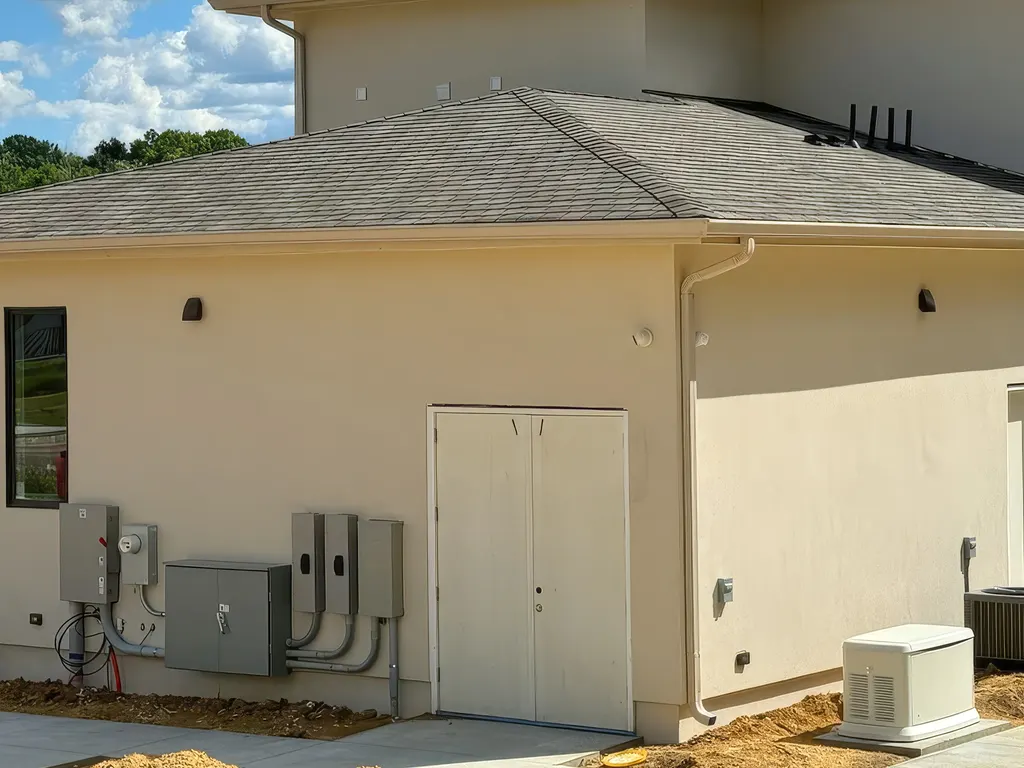
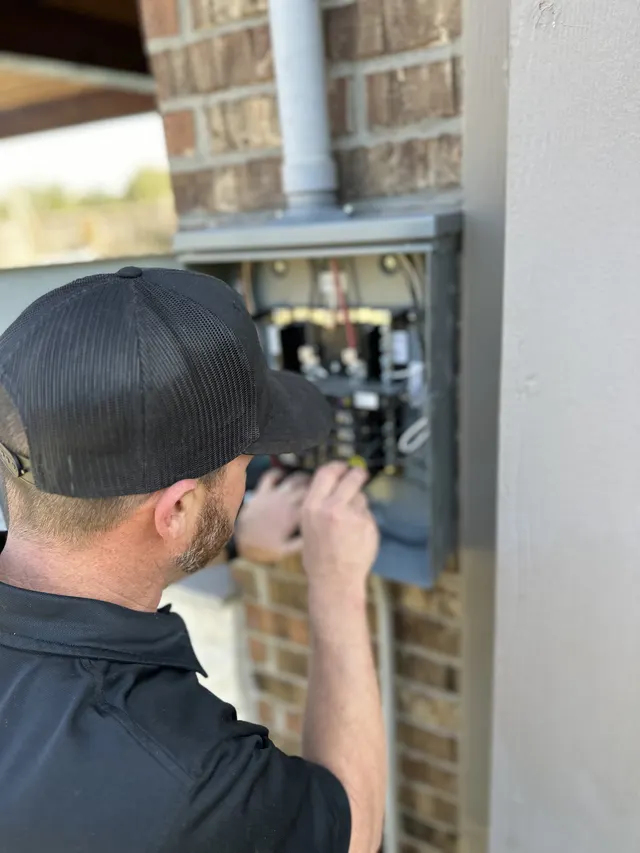
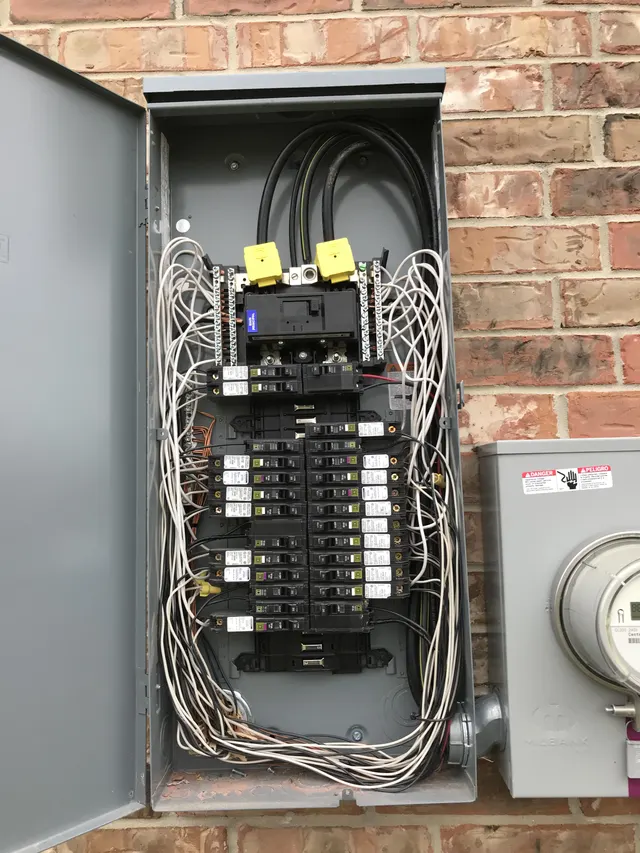






Quick answer
Standby generator sizing starts with the running wattage of every load you want powered, adds the starting surge of the largest motor, usually the air conditioning compressor, and then applies a margin for heat derating and future loads. Most Houston-area homes with two air conditioners land between 18 and 26 kW with load management, or larger for whole-home coverage without it.
Standby generator sizing is the one decision you cannot fix later without buying a second machine. Too small and the unit trips every time the second air conditioner tries to start on an August afternoon. Too large and you paid for engine, gas piping and pad you will never use. This guide walks through the calculation the way a licensed electrician does it on a Sugar Land, Richmond or Katy home, including the two shortcuts that matter most here: air conditioning starting current and load-shedding modules.
It applies to permanently installed natural gas or propane units. If you have not yet settled on standby versus portable, start with our complete guide to standby generators.
Key Takeaways
- Size a standby generator on running watts plus the starting surge of the largest motor, not on square footage.
- Air conditioning compressors are the dominant starting load in Houston homes; the nameplate LRA tells you how large.
- Load-shedding modules let a smaller generator run a whole home by staggering the big circuits.
- Air-cooled generators lose output in summer heat and on natural gas, so leave margin.
- Gas appliances common in Houston homes keep electrical loads lower than in all-electric regions.
- A licensed electrician's load calculation is part of the permitted generator installation.
What does standby generator sizing actually measure?
A standby generator is rated in kilowatts (kW), the real power it can deliver continuously at rated voltage. The sizing question is whether that number covers two demands at once.
Running load is the steady draw of everything switched on at the same time: refrigerator, lighting, television and a 3-ton air conditioner all add to one running total.
Starting load is the brief surge a motor draws the instant it starts, before the rotor is turning. Compressors, pool pumps, well pumps and air handler blowers all do this. The surge lasts a fraction of a second but can be three to six times running current, and a generator that cannot supply it lets voltage sag until its protection trips or the compressor stalls.
So the sizing target is the total running load of everything you want on, plus the starting surge of the single largest motor that could start while everything else is already running. That sum, with margin, is the generator you need. Square footage and main breaker size are poor substitutes: a 200-amp panel in Riverstone with gas heat, gas cooking and a gas water heater may run on far less generator than a smaller all-electric house.
How do you calculate the running load for a Houston home?
Walk the house with a notepad and the breaker panel open. For each load, use the nameplate wattage, or multiply nameplate amps by volts (120 or 240). Group them like this:
- Air conditioning. The condenser nameplate gives rated load amps (RLA) at 240 volts. A 3-ton system commonly runs at 3 to 4 kW; two systems double it. Each air handler blower adds several hundred watts.
- Kitchen. Refrigerator and freezer at a few hundred watts each; microwave around 1 to 1.5 kW; an electric range at 8 to 12 kW if you insist on cooking with it, which most families do not.
- Water. A gas water heater needs almost nothing. An electric tank unit is typically 4.5 kW; a whole-house electric tankless unit can exceed 20 kW and is usually excluded.
- Laundry. An electric dryer is roughly 5 kW.
- Pool. A single-speed 1 to 2 horsepower pump draws about 1 to 2 kW with a hard start; variable-speed pumps are gentler. Spa heaters are usually left off.
- Everything else. LED lighting, fans, routers, garage door openers, cameras, CPAP and medical equipment together are often under 2 kW.
- EV charger. A Level 2 charger at 32 to 48 amps is 7 to 11 kW. Decide now whether it stays on the generator side.
Count the loads you genuinely need during a week-long outage, not the theoretical maximum.
Why does air conditioning starting current decide standby generator sizing in Houston?
In Fort Bend County, generator sizing is about compressors. A standby generator that cannot start the air conditioning is an expensive way to keep the refrigerator cold during a July outage.
The number to find is LRA, locked rotor amps, printed on the condensing unit's nameplate beside RLA. LRA is the inrush current for the instant before the compressor turns, and on an older single-stage 4-ton unit it can be well over 100 amps at 240 volts. Manufacturers publish how much motor-starting capability each generator model has, and that figure, not the nameplate kW, is what a compressor is checked against.
Three ways to shrink the starting problem
- Soft-start kits. A soft starter ramps the compressor up over a fraction of a second and can cut inrush by more than half. It is a common add-on when a homeowner wants an air-cooled unit to run two systems.
- Newer equipment. Two-stage and variable-speed condensers start far more gently than single-stage units from the 2000s. If the HVAC is due for replacement anyway, doing it first can change the generator size you need.
- Staggering. Never let both compressors try to start at the same moment. That is what load-shedding modules are for, covered next.
A garage freezer on its own dedicated circuit is one more small compressor to count.
Whole-home or managed loads: which standby generator sizing approach is right?
There are two legitimate ways to design the installation, and the choice changes the generator size by a wide margin.
Whole-home sizing
The generator is large enough to start and run everything on the panel at once, with no management. It is the simplest design and the only one that lets a household act as though the outage is not happening. On a larger home in Memorial or Sienna with three or four HVAC systems and a pool, it usually means a liquid-cooled unit above 30 kW and a larger gas supply.
Managed loads with load-shedding modules
The transfer switch or a separate load-management controller watches generator output. Large circuits, typically each air conditioner, the dryer, the range, the pool pump and the EV charger, are wired through shedding relays. When the generator nears capacity, the controller holds off or drops the lowest-priority load and releases it once there is headroom, so the second compressor never starts while the first is starting.
The result is that a 22 to 26 kW air-cooled generator can carry a two-system home in Cinco Ranch, Aliana or Harvest Green that would otherwise need a far larger machine. On the hottest afternoons the high-draw conveniences wait their turn, which most households accept gladly.
The design also determines the transfer equipment, explained in our post on transfer switches vs interlock kits.
How do heat and fuel type change a standby generator's real output?
The kW on the box is a laboratory number. Three adjustments bring it down to what you get on a Houston pad.
- Fuel. Dual-fuel residential engines produce less on natural gas than on propane, because natural gas carries less energy per unit volume. Spec sheets list both ratings; use the natural gas figure if that is your fuel.
- Ambient temperature. Air-cooled engines are rated at a reference temperature and lose capacity as intake air gets hotter. A 100°F afternoon with the unit on a sun-baked west wall is the worst case and exactly when the outage load peaks. Liquid-cooled units are far less affected.
- Gas pressure. If the meter and piping cannot hold pressure at full engine demand, output falls. It is a supply problem, but it looks like an undersized generator.
Altitude is the fourth derate factor in most manuals and the one you can ignore here, since the whole service area sits near sea level. We design so that the natural gas, hot-day rating still starts the largest compressor with everything else running. If a proposal quotes only the propane rating at a mild temperature, ask for the hot-day natural gas number.
Sizing a standby generator for Sugar Land, Richmond and Katy homes
We do these load calculations across Fort Bend County every week, and the homes fall into a few patterns.
Master-planned homes built 2000 to 2025. Riverstone, Telfair, Aliana, Harvest Green, Cinco Ranch and Jordan Ranch homes usually have 150 to 200-amp service, two air conditioning systems, gas cooking, gas heat and often a gas water heater, so the compressors dominate the load. With load management, a 22 to 26 kW air-cooled unit is the common answer; a pool, a third HVAC system or an EV charger pushes toward the top of that range or into liquid-cooled territory.
1970s and 1980s homes. Older sections of Sugar Land, Pecan Grove, Quail Valley and Stafford frequently have 100 to 150-amp service and single-stage air conditioners with high inrush. A soft-start kit often does more for sizing than any other change, and we check the panel itself, because a generator cannot be tied into a Federal Pacific or Zinsco panel without a panel replacement.
Acreage and propane properties. Around Fulshear, Richmond and Rosenberg, well pumps and septic aerators add motor loads that must be covered, and propane delivers full rated output, which helps.
In every case the installation is permitted and inspected, by the city inside Sugar Land, Katy, Missouri City or Houston and by Fort Bend County outside city limits. Since the February 2021 freeze and Hurricane Beryl, most homeowners here want both air conditioners covered, which is why managed loads have become our default recommendation.
What are the most common standby generator sizing mistakes?
These are the errors we correct most often when reviewing another quote or a homeowner's own spreadsheet.
- Sizing from the main breaker. A 200-amp panel does not mean a 48 kW load. Panels are sized for capacity, not for what actually runs.
- Ignoring LRA. Adding up running watts and stopping there is the most common reason an installed generator trips when the air conditioner cycles on.
- Using the propane rating for a natural gas install. The difference can turn a comfortable margin into none.
- Forgetting the heat derate. The unit is tested in a mild lab and used in a Houston August.
- Counting an electric tankless water heater. It can exceed the whole generator. Exclude it or switch to gas.
- Leaving no room for future loads. A few kW of headroom now is cheaper than a second generator when the EV charger or pool arrives.
- Undersizing the gas supply. A correctly sized generator on an undersized gas line behaves like an undersized generator.
Weather is a sizing factor, but indirectly: heat raises the air conditioning load and the engine derate at the same time, so summer, not winter, is the design case. For the panel side, our post on load calculations for home circuits covers how wiring capacity is worked out.
Can you size a standby generator yourself, or do you need a licensed electrician?
You can and should do the first pass yourself. Listing the loads you actually want, reading the nameplates on both condensers, and deciding whether the EV charger and dryer need coverage makes the electrician's visit faster and the quote more accurate.
What a licensed electrician adds is the part that carries liability: the formal load calculation, checking a specific model's motor-starting capability against your compressors' LRA, verifying gas capacity under full load, choosing the transfer equipment, and inspecting the panel and service for anything that would fail inspection. That calculation is submitted with the permit. The Local Electrician also sets the load-shedding priority order with you, so it reflects how your household actually lives.
Sizing also drives cost. The factors that move the quote are:
- generator kW and air-cooled versus liquid-cooled,
- whole-home transfer switch versus load-center switch with shedding modules,
- gas meter upsizing and pipe run length,
- soft-start kits or HVAC changes,
- panel replacement if the existing panel is a known hazard, and
- conduit and pad distance from the meter.
The Local Electrician provides free estimates on standby generator installations, performs the load calculation during that visit, and offers financing. Call 832-271-1167 to schedule a sizing visit anywhere in Fort Bend County.
Frequently Asked Questions
What factors affect standby generator sizing?
The running wattage of every load you want powered, the starting surge of the largest motor (usually an air conditioning compressor), the fuel type since natural gas delivers less than propane, summer heat derating on air-cooled units, whether load-shedding modules will stagger the big circuits, and any future loads such as an EV charger or pool. Gas pressure and panel condition also shape the final design.
How do I calculate standby generator sizing for a home in Sugar Land?
List the loads you need during an outage and add their running watts from the nameplates. Find the locked rotor amps on each air conditioning condenser and add the largest starting surge to the running total. Apply margin for heat and natural gas derating. A licensed electrician confirms the figure against a specific model's motor-starting rating as part of the permitted installation.
What size generator do I need for my home?
Most Houston-area homes with two air conditioners and gas appliances land between 18 and 26 kW when load-shedding modules stagger the compressors, and larger if every circuit must run at once with no management. Larger homes with three or more HVAC systems, a pool and electric cooking usually move into liquid-cooled units above 30 kW. The right answer comes from a load calculation, not square footage.
Can weather impact standby generator sizing?
Yes, in two ways at once. Hot weather raises the air conditioning load, and it lowers the output of an air-cooled engine breathing hot intake air. Summer in Houston is therefore the design case. Winter outages like the February 2021 freeze add load only in homes with electric heat strips, which most gas-heated homes here do not rely on.
What are common mistakes in standby generator sizing?
Sizing from the main breaker rating instead of actual loads, ignoring compressor starting current, using the propane rating for a natural gas installation, forgetting the heat derate, including an electric tankless water heater, leaving no headroom for a future EV charger or pool, and pairing a correctly sized generator with an undersized gas line. Each of these shows up as nuisance tripping in the first real outage.
Do I need a bigger standby generator if I add an EV charger?
Not necessarily. A Level 2 charger draws 7 to 11 kW, which is a large load, but it can be wired through a load-shedding module so it charges only when the generator has headroom, or left off the generator side entirely. The Local Electrician sizes the system with the charger in mind so the decision is deliberate rather than discovered during an outage.